
Report Shows Impact of Federal Executive Actions on Maine’s Nonprofits
In early 2025, a series of federal executive actions created immediate upheaval for nonprofits through grant freezes, funding clawbacks, new restrictive requirements, and rapid policy changes implemented with minimal guidance.
At the same time, federal staffing reductions left some nonprofits unable to obtain necessary approvals, while new compliance burdens and uncertainty about already-awarded funding created an unstable environment that severely hampered organizational planning and program sustainability.
In summer 2025, the Maine Association of Nonprofits (MANP) administered a survey of Maine nonprofits to better understand the impact of recent federal funding cuts and freezes on the sector.
Key Findings
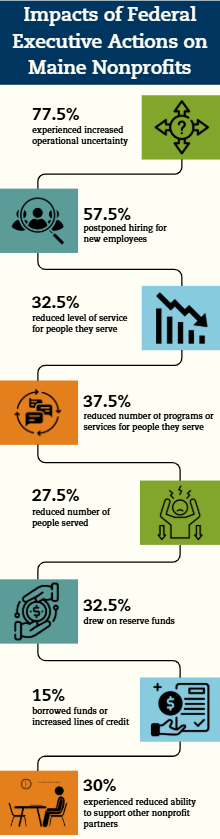 The financial impact of the federal executive actions on Maine's nonprofit sector has been substantial and widespread.
Of the 59 survey respondents who received federal funding, 67.8% experienced funding delays, reductions, or cancellations due to 2025 federal executive actions, with losses ranging from $10,000 to over $12.7 million.
Beyond outright cancellations, many nonprofits reported uncertainty about whether delayed payments represent temporary freezes or permanent losses, complicating their ability to plan and maintain services. The cumulative effect represents millions of dollars in lost or inaccessible federal funding for Maine nonprofits at a time when community needs remain high and nonprofits are already stretched thin.
The operational impacts of 2025 federal executive actions on Maine nonprofits have been severe and far-reaching. More than three-quarters (77.5%) of survey respondents reported increased operational uncertainty.
Nonprofits are postponing hiring, reducing staff and programs, and depleting reserves or taking on debt. Nonprofits serve as the backbone of Maine's social infrastructure, providing essential services that government and the private sector cannot or will not deliver. When nonprofits reduce staffing, cut programs, or decrease service levels, real people in Maine communities lose access to critical support.
The ripple effects extend beyond individual organizations: 30% reported reduced ability to support other nonprofit partners.
Ultimately, these disruptions don't just harm individual organizations. They erode the social safety net that protects Maine's most vulnerable residents and diminish the vital community-building work that strengthens civic life across the state. At a time when economic pressures, aging infrastructure, and social challenges demand robust community responses, weakening the nonprofit sector leaves Maine less equipped to address both current needs and future opportunities.
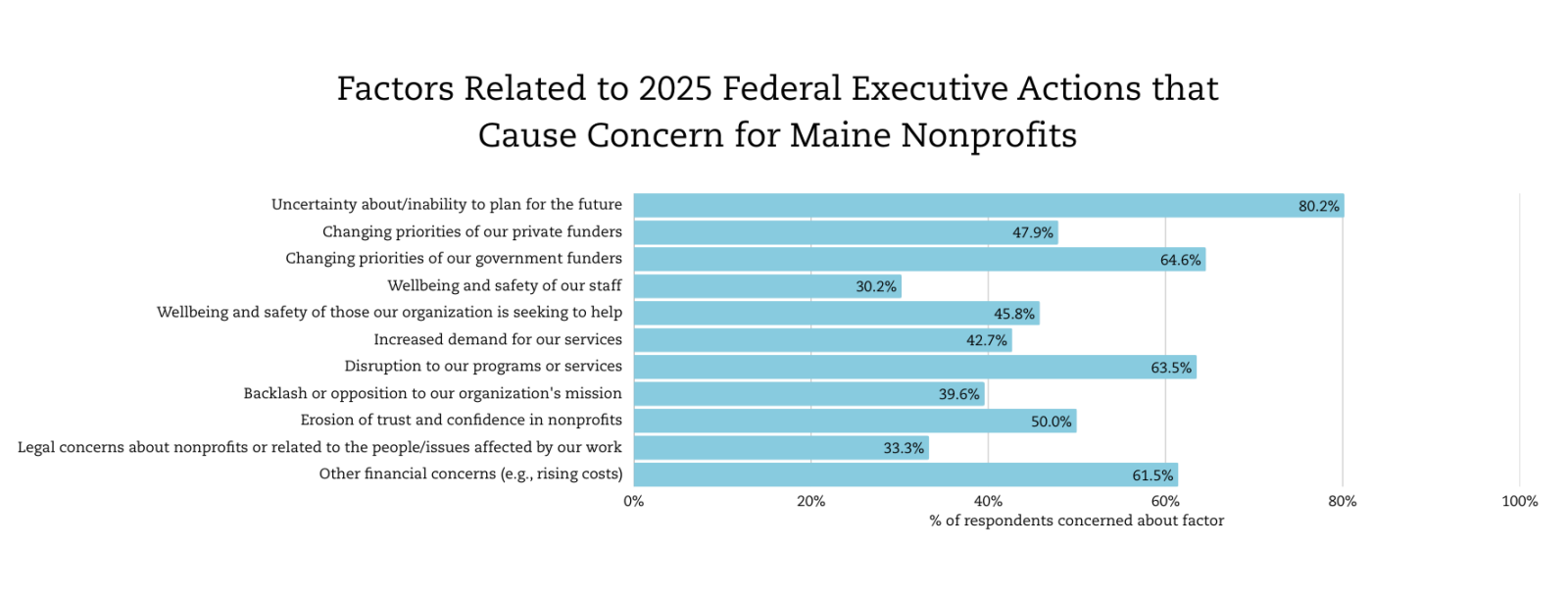
Nonprofits are deeply concerned about longer-term consequences of the federal executive actions. The most pervasive worry, shared by 80.2% of respondents, is the inability to plan for the future, which undermines strategic decision-making and organizational sustainability.
This uncertainty is compounded by shifting funding landscapes as both government and private funders re-calibrate priorities. Another significant concern is the potential for eroding public trust and potential backlash against organizational missions, threatening the sector's social capital and legitimacy. Organizations face a painful contradiction: increased demand for services precisely when their capacity to deliver is compromised. Add to this worries about the wellbeing and safety of staff and clients, along with legal uncertainties, and the picture becomes clear: Every responding organization reported one or more pressing concerns due to the 2025 federal executive actions.
Immediate Impacts, Long-term Damage
The immediate impacts are already visible in reduced services, postponed hiring, depleted reserves, and thousands of Maine residents losing access to critical support. Yet the longer-term consequences may be even more severe: erosion of public trust in nonprofits, weakening of collaborative networks, loss of institutional knowledge as experienced staff leave the sector, and diminished capacity to respond to community needs precisely when demand for services is increasing.
As Maine nonprofits serve populations ranging from vulnerable seniors and people with disabilities to rural communities seeking infrastructure support and young people pursuing educational opportunities, the consequences extend far beyond organizational budgets.
They represent a fundamental threat to the health, safety, and economic vitality of communities across the state.
Addressing these challenges will require sustained advocacy, meaningful policy reforms at both state and federal levels, and recognition that investing in strong nonprofit-government partnerships is essential to Maine's prosperity and the well-being of all its residents.
Thank you to MEHAF for supporting this research.
This is the first data released from MANP's summer 2025 survey; keep an eye on our blog in early 2026 for continued releases.
If you'd like to connect with MANP's advocacy work in a deeper way, consider joining our Advocacy Network (now with a sliding scale membership model!).